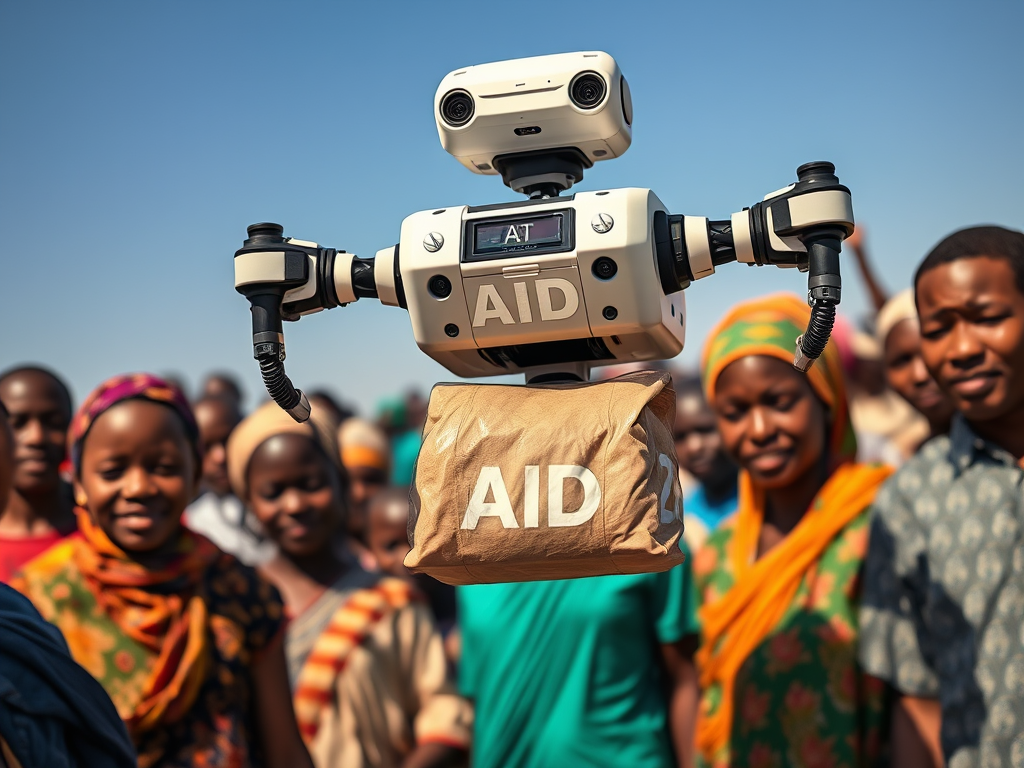
The humanitarian landscape, like all other sectors, is undergoing a digital transformation. More and more solutions are being delivered in the field using digital tools and platforms, from mobile applications for cash transfers to satellite imagery for disaster response mapping. This digital shift generates massive amounts of data—beneficiary information, operational metrics, environmental data, and real-time field reports—creating both unprecedented opportunities and significant challenges for humanitarian organizations.
As artificial intelligence becomes increasingly accessible and powerful, the humanitarian sector stands at a crossroads. While AI promises to revolutionize how we respond to crises and support vulnerable populations, it also introduces complex risks that require careful consideration and proactive management.
The opportunities of AI in the humanitarian work
Enhanced Business Intelligence and decision-making
AI’s ability to process and analyze vast datasets offers humanitarian organizations unprecedented insights into their operations and impact. Machine learning algorithms can identify patterns in beneficiary data, helping organizations understand which interventions are most effective for specific populations or contexts. It can also help identify shortfall in the aid delivery and help put in place remediation plan (better training of staff, restocking of medecine, etc). Predictive analytics can forecast needs, enabling proactive rather than reactive responses to emerging crises.
For instance, AI can analyze historical data on seasonal migration patterns, climate conditions, and economic indicators to predict where food insecurity is likely to emerge, allowing organizations to pre-position resources and respond more quickly when crises unfold.
Trend detection and early warning systems
AI excels at detecting subtle patterns that human analysts might miss. In humanitarian contexts, this capability can be transformative for early warning systems. Natural language processing can analyze social media posts, news reports, and community feedback to identify emerging tensions or deteriorating conditions before they escalate into full-blown crises.
Computer vision applications can process satellite imagery to detect changes in agricultural production, population movements, or infrastructure damage, providing real-time situational awareness that enables faster, more targeted responses.
Improved solution design
By analyzing the effectiveness of past interventions across different contexts, AI can help humanitarian organizations design more targeted and effective programs. Machine learning models can identify which combinations of interventions work best for specific demographic groups or in particular geographic areas, leading to more personalized and impactful humanitarian assistance. AI can also be a driver of innovation,(not inventing new things, as it works on existing data), but helping simulate the effectiveness of new solutions designed by humans.
Operational efficiency
Beyond programmatic benefits, AI can significantly enhance the internal efficiency of humanitarian organizations. Automated systems can streamline routine tasks such as data entry, report generation, and compliance monitoring, freeing up staff time for more strategic work. Especially in the area of donors relationship, where reporting is highly time-consuming. AI LLM is particularly appropriate for creating ad hoc reporting for donors.
But it comes with quite some risks that need to be addressed
Ethical considerations, bias, and limitations
AI systems are only as good as the data they’re trained on, and humanitarian data can reflect existing inequalities and biases. If historical data shows that certain groups received less assistance due to discrimination or access barriers, AI systems trained on this data may perpetuate these inequities. In the medical fields, if models are trained on populations with very different living environments (standard of living, nutrition, availability of care, etc.) the recommendations can be very erroneous. The “do no harm” principle central to humanitarian work requires organizations to carefully examine AI systems for potential bias and discrimination.
Moreover, the use of AI in humanitarian settings raises fundamental questions about human dignity and agency. Automated decision-making systems that determine who receives assistance or what type of aid they get must be designed with human oversight and the ability for beneficiaries to understand and appeal decisions.
FInally, today’s AI is very relevant when operating in stable environment with accurate data. In highly volatile environments or crisis periods, as it often happens in emergency settings, AI models can be very wrong (the recent COVID crisis or Ukraine war proved how it could be very dangerous to trust blindly AI tools).
Data protection and privacy
Even more so in the humanitarian sector, data protection is vitaly critical. Humanitarian organizations handle some of the most sensitive personal data imaginable—information about displaced populations, survivors of violence, and individuals in crisis. The use of AI often requires aggregating and analyzing this data in ways that could expose individuals to additional risks if not properly protected.
In conflict zones or areas with authoritarian governments, inadequate data protection could put beneficiaries in danger. Organizations must ensure that AI systems are designed with privacy by design principles and that data is secured against both cyber threats and potential misuse by bad actors.
Environmental impact and resource scarcity
The computational power required for AI systems often relies on energy and water-intensive data centers. When humanitarian organizations deploy AI solutions in low and middle-income countries—the very regions they aim to serve—there’s a risk of contributing to resource scarcity. The irony of using technologies that strain local power grids and water supplies while trying to address humanitarian needs cannot be ignored.
This challenge is particularly acute when organizations rely on cloud-based AI services that may be hosted in regions where they compete with local populations for scarce resources.
Capacity gaps and inappropriate usage
Perhaps the most immediate risk facing the humanitarian sector is the gap between AI’s capabilities and humanitarian workers’ understanding of these technologies. Without adequate training and technical literacy, staff may use AI tools inappropriately, make decisions based on flawed outputs, or fail to recognize when systems are producing biased or inaccurate results.
This knowledge gap can lead to over-reliance on automated systems, under-estimation of risks, or misinterpretation of AI-generated insights, potentially undermining the effectiveness of humanitarian interventions.
Creating the path forward
Investing in staff training and capacity building
The foundation of responsible AI use in humanitarian settings is a workforce that understands both the potential and limitations of these technologies. Organizations must invest in comprehensive training programs that go beyond basic technical skills to include ethical considerations, bias recognition, and critical evaluation of AI outputs.
Training should be tailored to different roles within organizations, from field workers who interact with AI-powered tools to senior managers who make strategic decisions based on AI-generated insights. Ongoing education is essential as AI technologies continue to evolve rapidly.
Developing clear policies and guidelines
Humanitarian organizations need robust policies that govern AI use, covering everything from data collection and storage to algorithm selection and output interpretation. These policies should be grounded in humanitarian principles and include clear protocols for human oversight, beneficiary consent, and transparency.
Policies should also address procurement decisions, ensuring that organizations select AI tools and services that align with their values and operational requirements. This includes evaluating vendors’ data protection practices, data hosting, algorithm transparency, and environmental impact.
Fostering innovation for relevant use cases
Rather than adopting AI solutions designed for commercial contexts, the humanitarian sector needs technologies specifically designed for its unique challenges and constraints. This requires collaboration between humanitarian organizations, technology developers, and affected communities to identify priority use cases and develop appropriate solutions.
Innovation should be guided by humanitarian needs rather than technological possibilities, ensuring that AI development serves to enhance rather than replace human-centered approaches to crisis response.
Building collaborative networks
No single organization can address the challenges of AI in humanitarian work alone. The sector needs collaborative networks that enable knowledge sharing, joint standard-setting, and collective problem-solving. These networks should include not only humanitarian organizations but also technology companies, academic institutions, and most importantly, the communities that humanitarian organizations serve.
Going forward
AI offers tremendous potential to enhance humanitarian response and improve outcomes for crisis-affected populations. However, realizing this potential requires careful attention to the risks and challenges that accompany these powerful technologies.
The path forward lies not in avoiding AI, but in approaching it thoughtfully and responsibly. By investing in capacity building, developing appropriate policies, and fostering innovation that serves humanitarian purposes, organizations can harness the power of AI while staying true to the fundamental humanitarian principles of humanity, neutrality, impartiality, and independence.
 Conseil en stratégie et organisation
Leave a comment